Comparison of Low Loss and Lifespan Performance of Fiber Optic Connectors
LC connectors generally offer the lowest insertion loss and longest lifespan among common fiber optic connectors, while MPO connectors provide high-density solutions with slightly higher loss and reduced mating cycles.
Low Loss Performance
Insertion Loss (IL) and Return Loss (RL) are the primary metrics for evaluating optical performance. IL measures the optical power lost at a connection point, with lower values indicating better performance, while RL measures reflected light, with higher values being preferable .
- LC Connectors: Featuring a 1.25 mm ceramic ferrule, LC connectors provide precise alignment, resulting in insertion loss typically between 0.1–0.3 dB. Their small ferrule size and high concentricity reduce lateral misalignment, enhancing low-loss performance . LC connectors also support APC and UPC polishing for improved return loss .
- SC Connectors: With a larger 2.5 mm ferrule, SC connectors exhibit insertion loss around 0.25–0.5 dB. The larger ferrule can introduce slight alignment challenges, making them slightly less efficient than LC connectors .
- MPO Connectors: Multi-fiber MPO connectors, designed for 12–72 fibers, have insertion loss ranging from 0.2–0.5 dB, depending on fiber count and alignment precision. While suitable for high-density applications, their multi-fiber alignment complexity can increase loss compared to single-fiber LC or SC connectors . High-quality low-loss connectors achieve superior performance through zirconia ceramic ferrules, tight inner diameter tolerances, and precise polishing techniques, sometimes including fiber core tuning to minimize lateral misalignment .
Lifespan and Durability
Connector lifespan is measured in mating cycles, indicating how many times a connector can be connected and disconnected before performance degrades.
- LC and SC Connectors: Both typically support 500–1,000 mating cycles due to robust ceramic ferrules and simple single-fiber alignment .
- MPO Connectors: Due to the complexity of aligning multiple fibers simultaneously, MPO connectors generally support around 500 mating cycles, slightly lower than LC/SC connectors . Durability is also influenced by connector design. For example, LC connectors with latch mechanisms and SC connectors with push-pull couplings provide mechanical stability, while MPO connectors require careful handling to avoid misalignment or contamination .
Standards and Reliability
Compliance with IEC standards ensures consistent optical performance and mechanical reliability. LC connectors, standardized under IEC 61754-20, offer high packing density and consistent low-loss performance, making them ideal for data centers and high-density environments. SC connectors follow IEC 61754-4, while MPO connectors adhere to IEC 61754-7 for multi-fiber applications .
Summary
| Connector Type | Typical Insertion Loss | Return Loss | Mating Cycles | Best Use Case |
|---|---|---|---|---|
| LC | 0.1–0.3 dB | High | 500–1,000 | High-density, low-loss applications, data centers |
| SC | 0.25–0.5 dB | High | 500–1,000 | Telecom, CATV, legacy systems |
| MPO | 0.2–0.5 dB | Moderate | ~500 | Multi-fiber, high-density backbone networks |
In conclusion, LC connectors provide the best combination of low insertion loss and long lifespan, making them suitable for modern high-performance networks. SC connectors remain reliable for legacy systems, while MPO connectors excel in high-density applications but require careful handling to maintain low-loss performance. Proper ferrule quality, polishing, and adherence to IEC standards are critical for achieving optimal optical efficiency and durability.
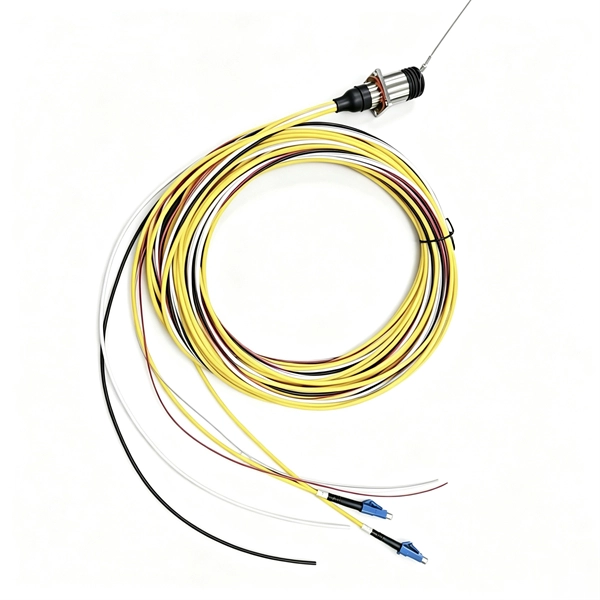 Factory
 Considerations for Optical Fiber Termination
Optical fiber cables and high-precision connectors are integral and necessary components of these systems. After appropriate optical
 Factory
 Expanded Beam & Physical Contact Fiber Optic Connectors
There are many types of fiber optic connectors, but each generally uses either physical contact or expanded beam technology. This
 Factory
 Optical Fiber Cable Design & Reliability
Fiber Lifetime - Optical “Low water peak” fiber (ITU G.652 C/D) is designed to prevent Hydrogen induced loss. Fiber is tested to IEC
 Factory
 Low Loss Connectors and Fiber Outside Diameter
Introduction designed for diverse fiber optic applications. But what exactly sets a fibe optic connector apart in terms of its merits? The
 Factory
 Fiber Optic Connectors: Detailed Guide to Types and Uses
Fiber optic connectors might be small, but they play a big role in ensuring fast and reliable data transfers. They link fiber optic cables,
 Factory
 Fiber Connectors
Fiber connectors are essential components used to terminate optical fiber cables, creating non-permanent or removable fiber joints
 Factory
 QUALITY GRADES OF FIBER OPTIC CONNECTORS
With ever rising data rates, the demands on the cabling that transmits the data, rise as well. The higher the data rates become, the
 Factory
 Understanding Optical Loss in Fiber Networks
Optical fiber is a fantastic medium for propagating light signals, and it rarely needs amplification in contrast to copper cables. High
 Factory
 Low-Loss Optical Fiber
Low-loss optical fiber has revolutionized the telecommunication industry in the last nearly five decades. Since the first low-loss optical
 Factory
 The FOA Reference For Fiber Optics
Fiber optic joints or terminations - where cables are terminated - are made two ways: 1) connectors that mate two fibers to create a
 Factory
 The FOA Reference For Fiber Optics
In order to establish a typical loss for connectors, it is necessary to test all connectors in a standardized fashion. Measurements of
 Factory
 Understanding Fiber Connectors and Fast Connectors: Types,
Learn about LC, SC, and field assembly fiber connectors — their structure, insertion loss, return loss, and applications